
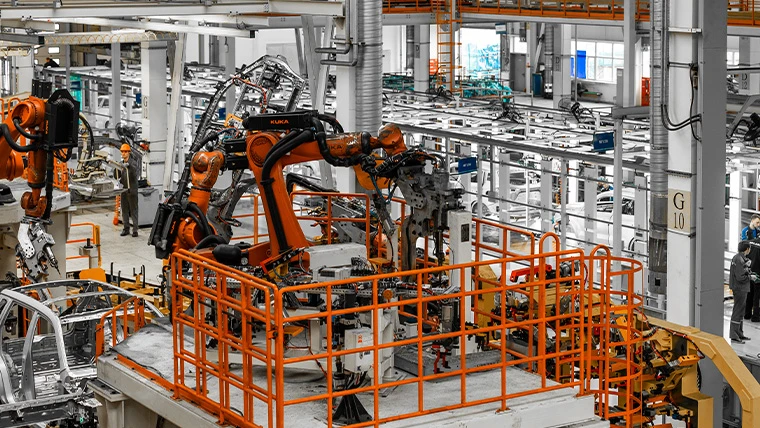
How Machine Vision is Transforming Manufacturing in Hong Kong & the Greater Bay Area
Hong Kong has always been a hub of trade, finance, and innovation. But as manufacturing pressure intensifies across the Greater Bay Area (GBA) — spanning Shenzhen, Guangzhou, Dongguan, and beyond — the need for smarter, faster, and more precise production processes has never been greater. Machine vision technology is at the forefront of this shift, quietly revolutionising factory floors and inspection lines across the region.
What Is Machine Vision?
Machine vision refers to the use of cameras, sensors, image processing software, and artificial intelligence to give industrial machines the ability to ‘see’ and interpret their environment. Unlike human inspection — which is subject to fatigue, inconsistency, and speed limitations — machine vision systems work 24/7 with pinpoint accuracy, processing thousands of images per minute to detect defects, verify labels, read codes, and guide robotic systems.
In simple terms: machine vision gives your production line eyes that never blink, never get tired, and never miss a defect.
The Manufacturing Challenge in Hong Kong & the GBA
Hong Kong’s manufacturing ecosystem is deeply intertwined with the Greater Bay Area — one of the world’s most dynamic industrial regions. Companies operating here face a unique set of pressures:
- Rising labour costs and talent shortages in traditional inspection roles
- Increasingly strict quality standards demanded by global export markets
- Higher product complexity, especially in electronics, pharmaceuticals, and FMCG
- Faster production cycles driven by e-commerce and just-in-time manufacturing
- Regulatory compliance requirements for packaging, labelling, and traceability
Manual quality inspection simply cannot keep pace. This is where machine vision steps in — not to replace workers entirely, but to automate repetitive, high-speed visual tasks so that human talent can be directed toward higher-value work.
Key Applications of Machine Vision in GBA Manufacturing
- Automated Quality Inspection
Machine vision cameras inspect every single product on the line — checking for surface defects, dimensional accuracy, colour consistency, and assembly correctness — at speeds impossible for human inspectors. Defective products are automatically rejected before they reach the customer, dramatically reducing returns and complaints.
- OCR/OCV — Label and Print Verification
Optical Character Recognition (OCR) and Optical Character Verification (OCV) systems verify that every label, batch number, expiry date, and barcode is correctly printed, legible, and in the right position. This is particularly critical in Pharmaceuticals, Food & Beverage, and Cosmetics — industries where incorrect labelling carries serious regulatory and safety consequences.
- Barcode & QR Code Reading
High-speed barcode and QR code readers ensure accurate tracking of products throughout the supply chain — from raw material intake to finished goods dispatch. In the GBA’s complex, multi-step production environments, this kind of real-time traceability is essential for efficiency and compliance.
- Robot Guidance & Positioning
Vision-guided robots use cameras to locate, pick, orient, and place components with micron-level precision. This is transforming assembly processes across the electronics and automotive sectors, enabling higher throughput with consistently lower error rates.
- Dimensional Measurement & Gauging
Non-contact vision measurement systems check the dimensions, geometry, and tolerances of machined or moulded parts at production speed — replacing slow, manual measurement processes and providing 100% inspection coverage rather than sampling.
Why Now? The GBA Advantage
The Greater Bay Area initiative has accelerated cross-border integration of supply chains, creating both opportunity and competitive pressure. Companies that adopt machine vision now are positioning themselves to:
- Win contracts from multinational brands demanding zero-defect supply partners
- Reduce operational costs as labour becomes more expensive
- Comply with China, Hong Kong, and international quality and safety standards
- Scale production rapidly without proportionally scaling headcount
- Build data-driven quality records for export certification and audits
How Unseen Era Supports Hong Kong & GBA Manufacturers
At Unseen Era, we have been delivering machine vision and industrial automation solutions since 2010. From our Hong Kong base, we work with manufacturers across the GBA to design, supply, and implement vision systems that fit their specific production environments.
Our portfolio includes GigE and USB vision cameras, smart machine vision sensors, industrial lighting solutions, camera lenses, barcode and QR code readers, and fully customised vision solutions developed in close collaboration with our clients.
We don’t believe in generic, off-the-shelf answers. Every factory is different, every challenge is unique — and our solutions reflect that.
Whether you are running a pharmaceutical packaging line in Shenzhen, an electronics assembly plant in Dongguan, or an FMCG operation in Hong Kong, Unseen Era has the vision technology and expertise to help you achieve a higher standard of quality — automatically.
Ready to See the Difference?
Machine vision is no longer a luxury reserved for large multinationals. Today, scalable and cost-effective vision solutions are accessible to businesses of all sizes across the GBA. The question is not whether to adopt machine vision — it is how quickly you can do so before your competitors do.
Contact the Unseen Era Hong Kong team today to discuss your requirements and explore what machine vision can do for your production line.
Email: hkg@unseenera.com